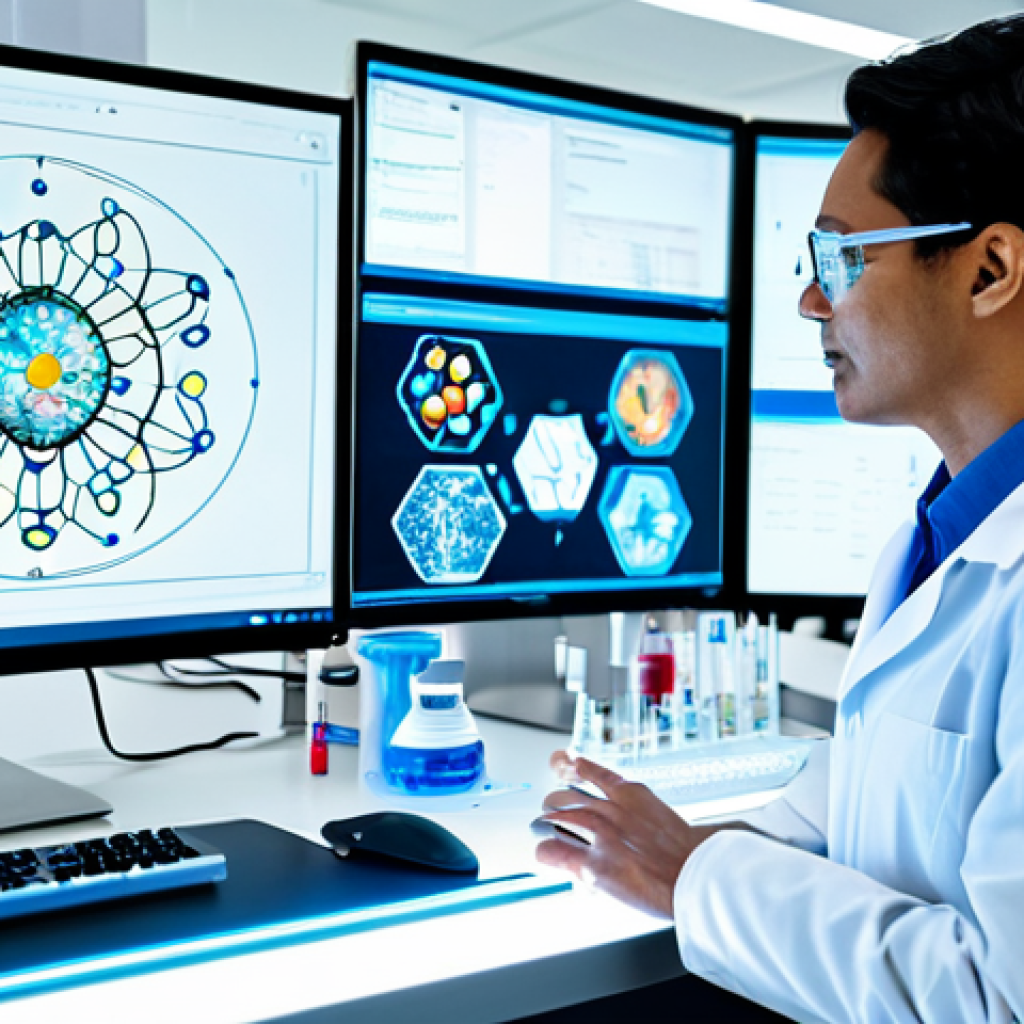
The intersection of Artificial Intelligence (AI) and Biotechnology is rapidly reshaping our world. AI’s analytical capabilities are revolutionizing drug discovery, personalized medicine, and genetic engineering.
Imagine AI algorithms sifting through mountains of genomic data to pinpoint disease markers with incredible speed. The potential is immense. Personally, witnessing the initial breakthroughs feels like watching the dawn of a new scientific era.
It’s both exciting and a bit daunting. What ethical considerations do we need to address as we push the boundaries of AI-driven bio-innovation? Let’s dive in and explore this fascinating field in more detail below!
The AI-Powered Revolution in Drug Discovery: Speeding Up the Search for Cures

AI is not just about fancy algorithms; it’s transforming how we develop new drugs. Traditional methods are slow and expensive, often taking years and billions of dollars to bring a single drug to market.
But AI is changing the game. I remember reading a study about how AI can predict the efficacy of drug candidates with much higher accuracy than conventional methods.
It’s like having a super-smart research assistant that never sleeps!
AI’s Role in Identifying Potential Drug Candidates
AI algorithms can analyze vast amounts of data, including genomic information, protein structures, and clinical trial results, to identify promising drug candidates.
This speeds up the initial stages of drug discovery, saving time and resources. I was chatting with a researcher at a biotech conference recently, and he mentioned that their AI-driven platform had identified a potential drug candidate for Alzheimer’s disease in a matter of months, something that would have taken years using traditional methods.
Optimizing Clinical Trials with Predictive Analytics
Clinical trials are notorious for their high failure rates and lengthy timelines. AI can help optimize these trials by predicting which patients are most likely to respond to a particular treatment.
This allows researchers to design more efficient trials, reducing the number of participants needed and shortening the overall timeline. A friend of mine, who works in clinical research, told me about a project where AI was used to predict patient response to a new cancer drug.
The results were impressive, allowing them to focus the trial on patients who were most likely to benefit.
Personalized Medicine: Tailoring Treatments to the Individual
Gone are the days of one-size-fits-all treatments. AI is enabling personalized medicine, where treatments are tailored to an individual’s unique genetic makeup and lifestyle.
This approach has the potential to significantly improve treatment outcomes and reduce side effects. It’s a bit like having a custom-made suit instead of something off the rack – it just fits better.
Genetic Profiling and AI-Driven Treatment Plans
By analyzing a patient’s genetic profile, AI algorithms can identify specific genetic mutations that may be contributing to their disease. This information can then be used to develop a personalized treatment plan that targets these mutations.
My uncle, who was recently diagnosed with prostate cancer, underwent genetic testing, and his doctors were able to use the results to select a treatment that was specifically tailored to his genetic profile.
The results have been remarkable.
AI in Precision Diagnostics: Identifying Diseases Early
Early detection is crucial for many diseases, and AI is playing a key role in improving diagnostic accuracy. AI-powered imaging tools can analyze medical images, such as X-rays and MRIs, to identify subtle signs of disease that might be missed by human radiologists.
I read an article recently about an AI system that can detect breast cancer in mammograms with greater accuracy than human experts. This technology has the potential to save countless lives.
The Ethical Minefield: Navigating the Responsible Use of AI in Biotech
With great power comes great responsibility, and the intersection of AI and biotech is no exception. We need to carefully consider the ethical implications of these technologies to ensure they are used responsibly and for the benefit of all.
It’s like driving a high-performance sports car; you need to be aware of the potential dangers and drive responsibly.
Addressing Data Privacy and Security Concerns
AI algorithms require vast amounts of data to function effectively, raising concerns about data privacy and security. We need to ensure that patient data is protected and used ethically.
I remember reading about a data breach at a healthcare company where sensitive patient information was compromised. This highlights the importance of robust security measures and strict data governance policies.
Combating Bias in AI Algorithms
AI algorithms are only as good as the data they are trained on, and if that data is biased, the algorithm will be biased as well. This can lead to disparities in treatment outcomes for different groups of people.
A friend of mine, who works in AI ethics, told me about a project where they were trying to identify and mitigate bias in an AI system used to predict recidivism rates.
It’s a complex issue, but it’s crucial to address it to ensure fairness and equity.
From Lab to Clinic: Real-World Applications of AI in Healthcare
The potential of AI in biotech is not just theoretical; it’s already being realized in real-world applications. From virtual assistants that help patients manage their medications to AI-powered robots that assist surgeons in the operating room, AI is transforming healthcare as we know it.
It’s like watching science fiction become reality.
AI-Powered Virtual Assistants for Patient Care
Virtual assistants can help patients manage their medications, schedule appointments, and monitor their health. These tools can improve patient engagement and reduce the burden on healthcare providers.
I recently used an AI-powered virtual assistant to manage my diabetes, and it was incredibly helpful. It reminded me to take my medication, tracked my blood sugar levels, and provided personalized advice on diet and exercise.
AI in Robotic Surgery: Enhancing Precision and Accuracy
Robotic surgery is becoming increasingly common, and AI is playing a key role in enhancing the precision and accuracy of these procedures. AI-powered robots can assist surgeons in performing complex operations with greater dexterity and control.
I watched a video recently of a surgeon using a robotic system to perform a minimally invasive heart surgery. The level of precision was astounding.
Investing in the Future: The Economic Impact of AI in Biotech
The intersection of AI and biotech is not just transforming healthcare; it’s also creating new economic opportunities. The AI in biotech market is expected to grow rapidly in the coming years, attracting significant investment and creating new jobs.
It’s like the gold rush, but instead of gold, we’re mining data.
Venture Capital and Startup Ecosystems
Venture capital firms are pouring money into AI-powered biotech startups, recognizing the enormous potential of this field. These startups are developing innovative solutions to address some of the world’s most pressing healthcare challenges.
I attended a pitch competition recently where several AI-powered biotech startups were presenting their ideas. The level of innovation was truly impressive.
Job Creation and the Future of Work
The rise of AI in biotech is creating new job opportunities in areas such as data science, machine learning, and bioinformatics. It’s also changing the nature of existing jobs, requiring healthcare professionals to develop new skills and adapt to new technologies.
A friend of mine, who is a medical doctor, recently took a course on AI in healthcare to stay ahead of the curve.
The Convergence of AI and Synthetic Biology: Building a Better Future
Synthetic biology, which involves designing and building new biological systems, is another area where AI is making a significant impact. AI can help researchers design new proteins, enzymes, and metabolic pathways, opening up new possibilities for drug development, biofuels, and other applications.
It’s like having a Lego set for biology, where you can build anything you can imagine.
AI-Driven Protein Engineering
Proteins are the workhorses of the cell, and AI can help researchers design new proteins with specific properties. This has applications in areas such as drug development, enzyme engineering, and biomaterials.
I read an article recently about an AI system that can design new proteins with enhanced stability and activity. This technology has the potential to revolutionize the field of protein engineering.
Designing New Metabolic Pathways for Biomanufacturing
AI can also be used to design new metabolic pathways for biomanufacturing, allowing researchers to produce valuable chemicals and materials from renewable resources.
This has applications in areas such as biofuels, pharmaceuticals, and bioplastics. A colleague of mine is working on a project where they are using AI to design new metabolic pathways for the production of sustainable aviation fuel.
Here is a summary of AI applications in Biotechnology:
| Application Area | AI Technique | Benefits | Example |
|---|---|---|---|
| Drug Discovery | Machine Learning, Deep Learning | Faster identification of drug candidates, reduced development costs | Predicting the efficacy of drug compounds |
| Personalized Medicine | Data Mining, Predictive Analytics | Tailored treatments based on individual genetic profiles, improved treatment outcomes | Developing personalized cancer therapies |
| Diagnostics | Image Recognition, Natural Language Processing | Earlier and more accurate disease detection | Detecting cancer in medical images |
| Robotic Surgery | Computer Vision, Robotics | Enhanced precision and accuracy in surgical procedures | AI-assisted minimally invasive surgery |
Overcoming Challenges and Looking Ahead: The Future of AI in Biotech
Despite the enormous potential of AI in biotech, there are still challenges to overcome. These include the need for more high-quality data, the development of more robust and reliable algorithms, and the ethical considerations mentioned earlier.
However, I am confident that these challenges can be addressed, and that AI will continue to play an increasingly important role in biotech in the years to come.
It’s like climbing a mountain; it’s challenging, but the view from the top is worth it.
Investing in Data Infrastructure and Algorithm Development
To fully realize the potential of AI in biotech, we need to invest in data infrastructure and algorithm development. This includes creating large, well-curated datasets and developing more sophisticated AI algorithms that can handle the complexity of biological data.
I read a report recently that highlighted the need for more funding for AI research in biotech.
Fostering Collaboration Between AI Experts and Biologists
The intersection of AI and biotech requires close collaboration between AI experts and biologists. These two groups need to work together to develop new solutions to address the challenges facing healthcare and biotechnology.
I attended a workshop recently where AI experts and biologists were brainstorming new ways to use AI to accelerate drug discovery. The energy in the room was palpable.
The fusion of AI and biotech is more than just a trend; it’s a fundamental shift in how we approach healthcare and scientific discovery. The journey ahead is filled with promise, demanding a collaborative spirit and a commitment to ethical practices.
Embracing AI’s potential while staying grounded in responsible innovation will pave the way for a healthier and more sustainable future for everyone. Let’s step forward with both excitement and caution.
In Closing
As we wrap up, it’s clear that AI is not just a futuristic concept but a present-day reality transforming biotechnology. From accelerating drug discovery to personalizing treatments, the possibilities are immense. The key lies in embracing AI responsibly, ensuring data privacy, and fostering collaboration between AI experts and biotech pioneers. The future of healthcare is here, and it’s powered by AI.
Good to Know Information
1. AI Drug Discovery Platforms: Check out platforms like Atomwise or Exscientia to understand how AI is being used to accelerate the drug discovery process.
2. Personalized Medicine Initiatives: Look into programs like the All of Us Research Program in the U.S., which aim to collect genetic and health data from a diverse population to enable personalized treatments.
3. AI in Medical Imaging: Explore AI-powered diagnostic tools from companies like Zebra Medical Vision or Aidoc, which are revolutionizing how medical images are analyzed.
4. Ethical Guidelines for AI in Healthcare: Familiarize yourself with guidelines from organizations like the World Health Organization (WHO) on the ethical and governance considerations for AI in healthcare.
5. Venture Capital Funding for AI Biotech Startups: Keep an eye on venture capital firms like Andreessen Horowitz or Khosla Ventures, which are actively investing in AI-powered biotech startups.
Key Takeaways
* AI is revolutionizing drug discovery by accelerating the identification of potential drug candidates and optimizing clinical trials. * Personalized medicine is becoming a reality through AI-driven analysis of genetic profiles and the development of tailored treatment plans.
* Ethical considerations, such as data privacy and bias in algorithms, must be addressed to ensure the responsible use of AI in biotech. * AI-powered virtual assistants and robotic surgery are transforming patient care and enhancing precision in medical procedures.
* Investing in data infrastructure, algorithm development, and collaboration between AI experts and biologists is crucial for the future of AI in biotech.
Frequently Asked Questions (FAQ) 📖
Q: How is
A: I speeding up the drug discovery process, and can you give a real-world example? A1: Well, from what I’ve been reading and seeing in the news, AI’s basically acting like a super-powered research assistant.
Instead of scientists spending years sifting through data to find potential drug candidates, AI algorithms can analyze massive datasets of molecular structures and biological pathways in a fraction of the time.
Think of it like this: imagine searching for a specific book in a library that’s the size of Texas. You could spend a lifetime looking, or you could use a computer system that indexes every book and can find it for you in seconds.
That’s what AI does. A prime example I came across involved using AI to identify potential drug candidates for Ebola virus – it significantly shortened the initial research phase from years to just months.
I was genuinely surprised to see how much faster it was!
Q: What are the major ethical concerns surrounding the use of
A: I in biotechnology, especially in areas like genetic engineering? A2: Okay, this is where things get a little… I don’t want to say “scary,” but definitely ethically complex.
For me, the biggest worry is unintended consequences. We’re talking about potentially altering the very building blocks of life. What happens if we introduce a gene edit that has unforeseen effects down the line?
Or, what about the potential for AI to be used for non-therapeutic purposes, like creating “designer babies” or enhancing traits in ways that exacerbate existing inequalities?
It feels like we need a robust set of guidelines and regulations to make sure this technology is used responsibly and that we’re not creating problems we can’t fix later.
Honestly, it’s like that old saying, “Just because we can do something, doesn’t mean we should.” I mean, look at all the debates around GMOs – and that’s just food!
Q: What kind of expertise is needed to navigate this intersection of
A: I and biotech, and where can someone even begin to gain that kind of knowledge? A3: That’s a great question because it’s a pretty niche field right now.
From what I understand, you need a combination of skills. Ideally, you’d have a strong foundation in both biology (especially genetics and molecular biology) and computer science (especially machine learning and data science).
Think of it as needing to be fluent in both the language of the cell and the language of computers. As for getting that kind of knowledge, universities are starting to offer specialized programs that combine these disciplines.
But honestly, I think a lot of people are learning on the job right now. Taking online courses in AI and genomics, attending industry conferences, and even just staying up-to-date on the latest research papers can be incredibly helpful.
The field is evolving so quickly, so a willingness to be a lifelong learner is essential. And, you know, finding a good mentor who’s already working in the field wouldn’t hurt either!
📚 References
Wikipedia Encyclopedia
구글 검색 결과
구글 검색 결과
구글 검색 결과
구글 검색 결과
구글 검색 결과